
Ad Disclosure
Sorting Through the Joel Embiid vs. Daryl Morey Game Management Rift

By Sean Barnard
Published:
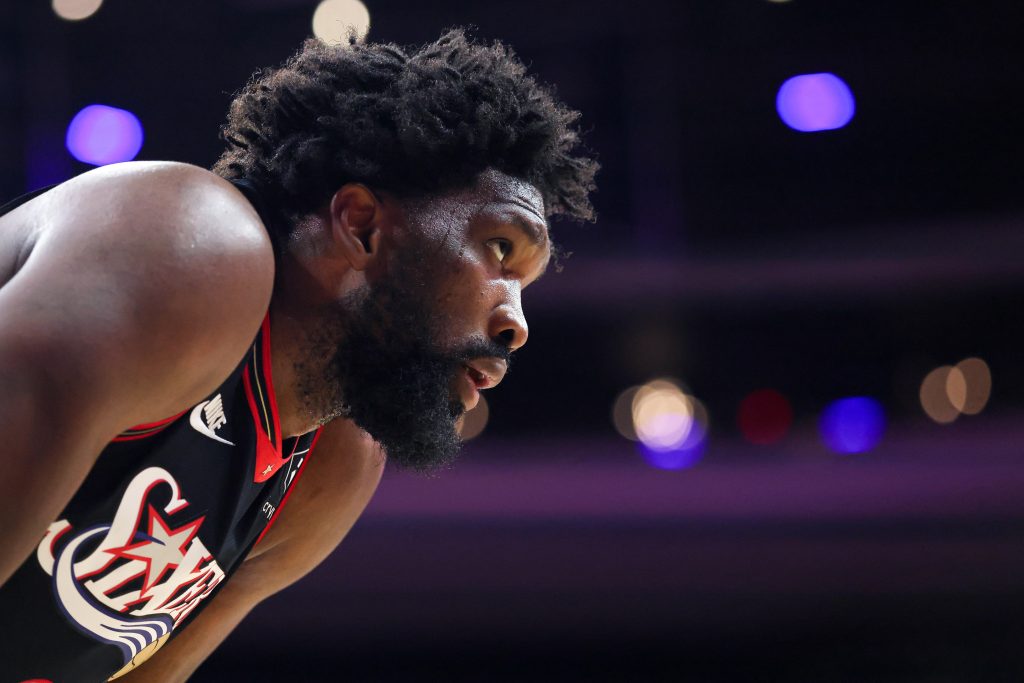
Load management is a phrase that’s been borderline synonymous with Joel Embiid’s injury status for quite some time. The former MVP is an all-time great talent whose body is failing him, and there’s been a revolving door of attempts for the best way to combat this.
In the wider scale of the conversation, Embiid gets a far worse reputation than he deserves for his time missed. He’s suited up for 38 games this year, just 19 last year as his injury issues hit a true low point, and 39 the season prior when the meniscus issues fully started to derail things. But in the six years before this, he suited up for 66, 68, 51, 51, 64, and 63 games. Sure, these don’t put you in Ironman conversations, but it’s on par with what has become the norm for the modern-day NBA star.
Injuries do not get better with age, and Embiid himself has been at the forefront of the conversation of changing the approach of his injury management this season. It was he who offered that he likely will never play back-to-back ever again in his career, he who led the conversation for why he would be shut down for the season last year and undergo another surgery, and seemingly, he who has raised the bar for what level he needs to be at to take the floor this year:
However, it seemingly was not Embiid who led the decision on not taking the floor during last week’s victory over the Wizards. What could initially be viewed as Embiid playing an April Fools’ joke and returning to his online trolling, the frustration in the matter became evident when the Sixers’ star spoke postgame:
“I was pissed off. I wanted to play basketball. I wasn’t allowed to play basketball so I think this is more of a question of Daryl Morey and whoever makes the decisions. I think going to Miami, I was pretty sick. But I understood how important the game was and, you know, I still want to give us a chance to go out and, you know, try to do something… I found out online that I wasn’t playing that night so that kind of caught me off guard and, yeah, that pissed me off. But then again, I guess they make the decisions so doesn’t matter what I think or not. I just got to follow.“
To lay out the full timeline here, Embiid played in Monday’s loss to the Heat and finished with 26 points, seven rebounds, and three assists. It was the most sluggish he’s looked since returning from his oblique injury, and he failed to impact the game the way the raw numbers would seemingly indicate. Embiid took questions after the game with cold medicine in his pocket and acknowledged that he was battling illness.
The Sixers were off on Tuesday, and when the initial injury report dropped for Wednesday’s matchup with the Wizards, there was no mention of Embiid. This changed on the morning of the game, when the 11 A.M. injury report had the Sixers star listed as “OUT” due to illness. The NBA now requires teams to submit an injury report every 15 minutes throughout a game-day which is a significant factor in this overall conversation. This is the sequence that he is referring to in the above quote, and when push came to shove, he did not suit up for a matchup which still resulted in a 153-131 Sixers win.
It’s also worth noting that he was originally listed as doubtful for Friday’s matchup with the Timberwolves due to the same illness. He was eventually upgraded to probable and available before helping the team produce a 115-103 win in a game that has a case for their best win of the season, given the context of the standings. Embiid finished with 19 points, 13 rebounds, and seven assists on 6-for-17 shooting. He looked out of it at the start of the game, but settled in as it progressed and filled the necessary role to get the result.
Why Was Embiid Ruled Out vs. Wizards?
The hope will be that the Sixers and Embiid can put any differences aside and buckle up for whatever semblance of a playoff opportunity they’ll face. But the Sixers’ star did not hide, and was seemingly even a bit eager, to dive into the difference between him and the organization when asked in his first media availability opportunity.
What also seems abundantly clear in the follow-up reporting is that this was an example of the Sixers putting their foot down on what flies and what doesn’t. Embiid mentioned in the above clip how he was unable to sleep until “five in the morning, or six” due to the illness. It does not feel like a significant leap that once he missed this film session or deemed himself unable to make it, he was ruled out for the game later that night. Both Nick Nurse and Daryl Morey did their best to be careful with their words, but confirmed it to be true:
Drawing a line in the sand that if a player is not well enough to make shoot around or a film session than they are not well enough to play in the game later that night is a totally fair organizational stance. But it also has not been a line that has been drawn in Embiid’s career.
It’s also fair to say this is a necessary and positive outlook change for both Embiid and the organization. But this is also a strange time to do it. The Sixers are three games away from the regular season ending, and the playoffs are upon us. Embiid has looked far closer to his MVP self than seemed possible when he has been on the floor this year, and it has been legitimate injuries that have sidelined him. The oblique issue that kept him out for 13 games occurred during game action, and his eclipsing 40 games is largely a positive and acceptable result given the expectations coming into the year.
Do the Sixers Deserve Praise for this?
The Sixers are trying to thread an impossible needle of limiting the wear-and-tear on Embiid enough to allow him a healthy postseason, while he is still on the floor enough to stay in form and keep the team in decent standings. It is largely the franchise’s responsibility to protect a player from themselves at times, and the Sixers have fallen short in this category over the years. Embiid himself has allowed this critique to rise to the surface, as he indicated in the biggest peek into Embiid’s mindset this summer in the ESPN deep dive, “Joel Embiid Sees You,” written by Dotun Akintoye:
“But the pressure of his rushed return from injury was starting to tell. He had been diagnosed with Bell’s palsy days before the series started, after he began suffering migraines. He was short of fitness because of the injury, visibly limping, worried about the integrity of his grotesquely swollen knee, enduring nearly round-the-clock treatment and forced to play heavy minutes in the most critical games of the season. His vision was blurry, and his head ached. He was hardly sleeping because his left eye wouldn’t close….”
“The Sixers lost the series in six games. Embiid averaged 33 points, 10.8 rebounds and 5.7 assists. He had nothing left late in games when the adrenaline wore off and the pain took hold. “I knew I only had about two quarters,” he says. “My body just was, like, ‘Nope, that’s it.’ There was nothing I could do. I shot probably, like, 10 percent in the fourth quarter.”
Embiid looks back at the series with ambivalence. “In those situations, you wish some of the people upstairs kind of had your back and were like, this is not OK,” he says. “You’re not playing.”
“I’ve had to stop Joel a couple of times,” says Martin, who left the team in 2019. “When he gets into competition mode, it’s really difficult to have a meaningful conversation. … And that was before he was super famous.”
Embiid worries that too often, he’s made the wrong call, allowed himself to be coaxed back to the court too soon, pushed himself because of what type of player and person he wanted to be, taxing his body and leaving him vulnerable to repeat injuries. This is one of the feelings he’s been trying to unpack in therapy.”
In fairness to the current front office, many of these Embiid management frustrations go back long before Morey and company arrived. While there are fair critiques of the current regime, it is pretty much undeniable that there is a level of competence with the decision-makers that was not the case in the early parts of Embiid’s career. At a minimum, at least Morey isn’t trashing his superstar on burner accounts and wearing abnormally large collars.
But changing the culture and what is allowed for a superstar is not the easiest task. This is especially the case when they are getting resistance from the very man they are attempting to protect.
What is Next for Embiid and the Sixers?
In the short-term, the goals for the season are pretty clear. The Sixers have clinched some sort of postseason opportunity, and Embiid is as close to whatever a healthy version of him is ahead of the postseason. Any hard feelings must be put to the side, and the responsibility is on Embiid to play to his peak and give the team its best chance at success. Winning is the best deodorant, and any level of postseason success would aid in these harsh feelings subsiding.
In the larger view, there have now been too many eyebrow raising comments to just brush to the side. Embiid has never been shy to express his feelings publicly, and these have been as pointed as they have ever been regarding his management. It would be interesting to be a fly on the wall in private conversations between him and management. It does not feel like a moot point to note the Sixers have quietly laid the foundation for the next era with Tyrese Maxey and VJ Edgecombe at the helm.
It’s also worth acknowledging that no level of harsh feelings changes the terms of his contract. Every other team in the league sees the same concerns regarding the star that the Sixers are struggling with, and signing up to pay him $58 million next year, $62.6 million the following season, and $67.3 million in 2028-29 is a daunting ask. Even if Embiid feels the relationship is fractured to a level where he doesn’t want to be here anymore, the hurdles to clear this are not short. This is especially the case given that Morey will have his heels dug in on maximizing value on the team’s best player. Morey was eager to publicly speak about how he was willing to wait out the entirety of Ben Simmons’ contract if the proper deal did not manifest itself during his holdout. Embiid, even while in the decline of his career, provides far more value than Simmons did, and one would think the same principles apply.
Neither side is blameless in the relationship seemingly hitting a public tipping point, and it feels the context of how this season ends is incredibly important. There is a world where they have a respectable playoff performance, the vision for the future looks clearer, and feelings settle down. There is also a world where offseason discussions reveal the gap in outlook moving is wider than it ever has been, and this very well could be the beginning of the end.
To some extent, this feels like a situation comparable to a toxic relationship in which both sides still need each other. But it is to be determined if this is the type of toxicity that couples counseling and playoff success can heal.
Sean Barnard has covered the Philadelphia 76ers and general Philly Sports for over six years in a variety of roles and for multiple outlets. Currently works as a Content Writer for DraftKings Network, Sixers/NBA Insider for Philadelphia's Fox Sports the Gambler, and co-host of Sixers & Phillies Digest on Youtube. Forever Trusting the Process.